
The third quarter of 2026 concluded with global financial markets showing remarkable resilience, even while navigating a complex web of macroeconomic friction, shifting monetary policy, and heightened geopolitical risk. Over the course of July, August, and September, the rapid-fire momentum that characterized the first half of the year gave way to a choppy, sideways consolidation across major equity indices. The S&P 500 managed a modest gain of 2.3% for the quarter, while the tech-heavy Nasdaq Composite rose 2.8%, keeping major equity benchmarks within striking distance of record highs and bringing the year-to-date return for broader U.S. markets to 12.6%.
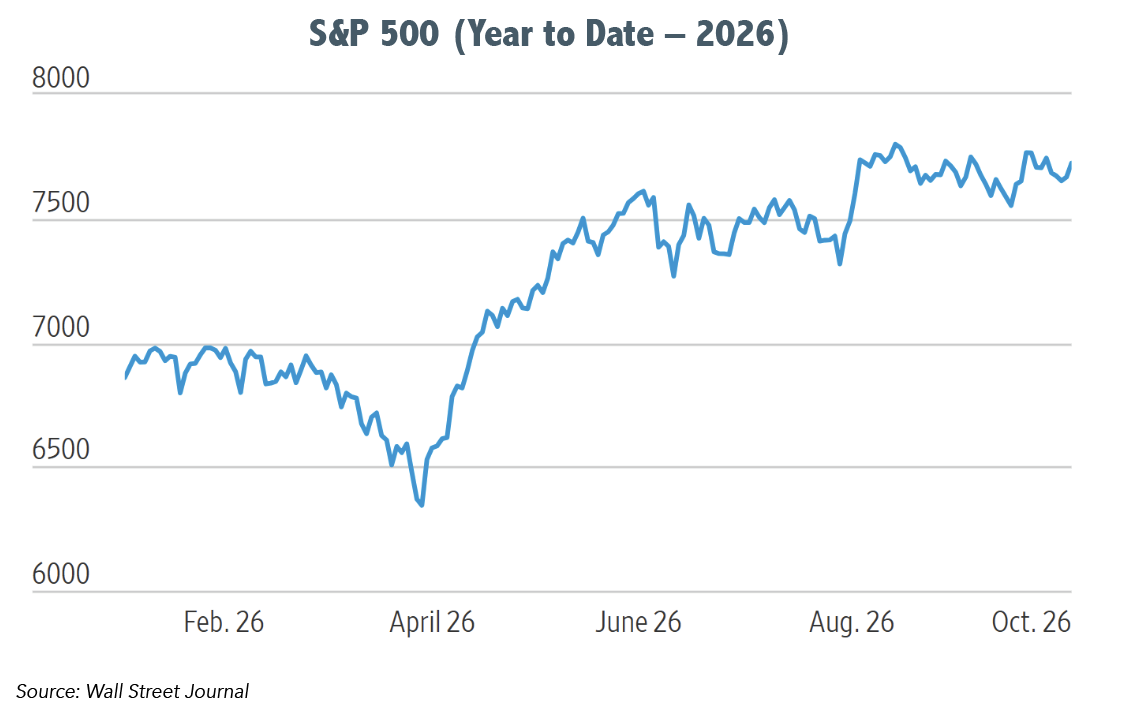
Underneath these stable index-level results, however, a shift occurred in market leadership and risk dynamics. The primary driver of the equity market’s multi-year bull run, the artificial intelligence (AI) infrastructure boom, encountered a speed bump as safety concerns and lofty valuation hurdles cooled investor enthusiasm for mega-cap chipmakers and technology providers. Simultaneously, the bond market experienced historic volatility, with a fixed-income sell-off driving long-term yields to multi-decade highs.
The defining catalyst of the quarter was a renewed energy and geopolitical shock out of the Middle East. The unresolved conflict with Iran, combined with transit blockages through the Strait of Hormuz, drove Brent crude oil prices past $100 per barrel during the summer. This energy price surge added unexpected upside pressure to global inflation, prompting the Federal Reserve, under newly appointed Chairman Kevin Warsh, to deliver its first interest rate hike in three years, a unanimous 25-basis-point increase in September.
As the quarter drew to a close, a late-September cool-down in inflation indicators and a decelerating U.S. labor market provided a complicated backdrop for the final months of the year. While real economic growth remained structurally intact, supported by corporate capital expenditures and robust business balance sheets, the combination of historic borrowing costs, elevated structural inflation, and a softening employment landscape signaled that the global economy may have entered a late-cycle period of consolidation.
Throughout Q3 2026, the U.S. and global economies continued to buck widespread predictions of an imminent recession, demonstrating an underlying durability that surprised many forecasters. U.S. economic activity remained net positive, tracking at an annualized real GDP (Gross Domestic Product) growth rate of roughly 1.5% to 2.0%. The most significant domestic economic development in Q3 was a pronounced deceleration in employment growth, culminating in an underwhelming September jobs report. Concurrently, the unemployment rate ticked up to 4.2%, and the volume of active job openings (JOLTS report) fell to 7.079 million. This cool-down in payroll expansions indicates that high corporate borrowing costs may have forced businesses to freeze hiring.
Adding to the corporate cost environment was the implementation of a more aggressive U.S. tariff framework. New baseline tariffs ranging from 10% to 12.5% were imposed across roughly 60 global economies, making international market access significantly more expensive and unpredictable. These protectionist measures have forced global logistics and manufacturing operations to absorb higher supply-chain friction, contributing to a broader slowdown in global trade volumes. Euromonitor International lowered its full-year 2026 global real GDP growth to 3.0% in light of these combined energy and trade shocks.
Monetary policy took center stage during the third quarter as the transition of leadership at the Federal Reserve coincided with a pivot in the inflation trajectory. Markets closely monitored the tone of the newly seated Fed Chair, Kevin Warsh, looking for clues on how the central bank would balance a softening job market against persistent price pressures. Throughout July and August, consumer price metrics remained stubbornly above target, driven by the Middle Eastern conflict and its subsequent pressure on domestic fuel prices. The Personal Consumption Expenditures (PCE) price index hovered around an annualized 3.7% rate for much of the summer, far exceeding the Fed’s long-term 2.0% objective.
Faced with the threat of unanchored inflation expectations, the Federal Open Market Committee (FOMC) took decisive action at its September 15–16 policy meeting. In a unanimous vote, the Fed raised the federal funds rate by 25 basis points to a target range of 3.50% to 3.75%. While the size of the hike was modest, its signaling value was immense: it marked the first interest rate hike in three years, definitively breaking the multi-year cycle of monetary easing and steady pauses. Chairman Warsh communicated that the central bank remains fully prepared to prioritize price stability, signaling to the bond market that the target rate will likely remain at these restrictive levels well into 2027.
The aggregate performance of equity markets in Q3 concealed a rotation under the surface, as investors moved away from momentum-driven technology into value-oriented and defensive sectors. For over three years, the undisputed engine of global equity returns has been the artificial intelligence (AI) revolution. Massive capital allocations into AI hardware, cloud infrastructure, and semiconductor manufacturing drove select companies to historic valuations. In Q3 2026, however, that trade slowed to a crawl. The primary catalyst for this shift was a growing chorus of internal safety warnings and structural concerns voiced by prominent AI executives and research institutions. Fears regarding the rapid, unvetted deployment of advanced models, combined with mounting skepticism regarding the near-term monetization timelines of these multi-billion-dollar infrastructure investments, prompted institutional investors to re-evaluate their exposure.
Despite the equity market’s flat headline trajectory, corporate fundamentals remained structurally robust. According to FactSet data, S&P 500 companies are projected to report a year-over-year revenue growth rate of 12.3% for Q3 2026, marking the third consecutive quarter of double-digit top-line expansion. Crucially, this revenue growth was broad-based, with all eleven sectors of the S&P 500 projected to post positive year-over-year revenue gains, led by Tech, Energy, and Communications. This earnings stability helped preserve reasonable market valuations, leaving the aggregate forward 12-month P/E ratio for the S&P 500 at a balanced 19.0.
If the equity market was characterized by a quiet consolidation, the fixed-income market was characterized by outright capitulation. The third quarter of 2026 witnessed one of the deepest bond market sell-offs in recent memory, resetting borrowing costs across the financial system. The driving force behind the fixed-income rout was a combination of persistent inflation, heavy sovereign debt issuance, and the realization that central banks would not be cutting interest rates anytime soon. The yield on the benchmark 10-year U.S. Treasury note surged past 5.34%, marking its highest level since 2002 and booking the steepest quarterly yield gain seen this century. Long-duration paper suffered even worse damage, with the 30-year U.S. Treasury yield peaking at 5.62%. Because bond prices move inversely to yields, major fixed-income indices finished the third quarter in the red.
Commodity markets in Q3 2026 were entirely dictated by geopolitical brinkmanship in the Middle East, serving as the core transmission mechanism for the inflation volatility felt worldwide. The geopolitical detente achieved briefly at the end of the second quarter dissolved early in July as negotiations between Western mediators and Iranian officials lost momentum. Renewed hostilities resulted in severe operational disruptions and naval blockages around the Strait of Hormuz, a vital maritime chokepoint responsible for the transit of roughly one-fifth of the world’s petroleum supply. The sudden re-imposition of a geopolitical risk premium sent energy markets into overdrive. Brent crude oil prices surged by 42% over the summer, comfortably breaking past the psychologically significant $100-per-barrel threshold. This dramatic spike immediately impacted consumer sentiment, driving domestic gasoline prices higher and feeding directly into headline CPI calculations.
The energy shock would have been substantially worse if not for highly coordinated policy interventions by Western economies. By late September, signs of recovering export volumes and reports of quiet, indirect talks between U.S. and Iranian officials in neutral locations began to cool the energy market. West Texas Intermediate (WTI) crude pulled back to $90.71 per barrel by the final days of the quarter, providing a soft landing for global markets entering October.
The third quarter of 2026 will be remembered as a transitional phase where the global economy proved its structural resilience while adjusting to a far more demanding financial environment. The convergence of the first Federal Reserve interest rate hike in three years, a generational bond market sell-off, a cooling of the over-extended artificial intelligence trade, and a localized energy shock tested investor resolve. The fact that major equity benchmarks emerged from this gauntlet largely unscathed is an indicator of robust corporate health and solid consumer balance sheets.
Entering the final quarter of the year, the macroeconomic equation has grown increasingly nuanced. The Federal Reserve finds itself in a delicate balancing act: the sharp slowdown in September payrolls signals that the labor market is losing its cushion, yet inflation remains structurally sticky and vulnerable to any fresh flare-ups in the Middle East. With the U.S. midterm elections on the horizon in November, political gridlock is expected to persist, rendering any meaningful legislative action on growing fiscal deficits or national debt highly unlikely. Consequently, the burden of steering the economic ship remains entirely on monetary policy and corporate execution. Investors are entering Q4 with a heightened focus on corporate fundamentals, demanding clear proof of earnings monetization rather than speculative technological promises as the global economy appears to transition into a slower, late-cycle expansion.
Looking forward, markets will remain volatile and unpredictable as always. Investors should never panic but embrace intelligent planning, proper diversification and trusting in the counsel of their professional advisors to help them confidently navigate a path forward.
Ignore the friction, stay the course.